
|
|
|
|
|
|
|
It was initiated in 1994 by the Regional Council of Alsace with the support of both General Councils of the Lower and Upper-Rhine. The missions of the Regional Office of Bilingualism (ROBI) take place through the policy of development of bilingualism and the promotion of the regional language implemented by the Regional Council in co-operation with other Alsatian Communities and the State, especially within the framework of the State Agreement. The matter at issue is the preservation of the linguistic identity of our region and ensuring a constant vitality of the regional language in both its forms - as a dialect and as Standard German - which constitutes at the same time : - an essential component of the specificity of Alsace - an asset taken for granted by firms and organizations dealing with the economic development on the market of goods, of public utility undertaking and of employment - a base for the regional potentialities in communication and creation - a capital element of Alsatian cultural life and of its diffusion The ROBI interferes with public or private partners (Department of Education, Alsatian Theatres, cultural associations and family associations) in order to promote the transmission of the dialect which is a genuine " natural resource " -, from generation to generation, and to enable its learning by the non-dialect speakers (popular Universities, realization of a method on CD-Rom). The ROBI also contributes to the development of French-German bilingual teaching (including as much as possible the dialect) and informing the families and the public in co-operation with the Department of Education, Associative Schools, the Federations of Pupils' Parents and local Communes. The ROBI also contributes in the diffusion of knowledge into sociolinguistics, psycholinguistics, bilingual pedagogy, etc... through lectures and debates about the matter, and the constitution of a library and a documentation center. It is at the disposal of everyone : politicians, decision makers from the public and private sectors as well as the public in general in order to provide all information or advice, to carry out all studies and search about the regional language and bilingualism (for example a board of expert consultants so as to ensure the continuousness and the consistency of the patrimony of our toponymy as well as the protection of the linguistic environment such as " bilingual street -name plates "). Besides, it also manages to inform on those matters outside of the region. Its action particularly appears through : -the production and the diffusion of video-film and information folios due to explain the data and the interests about bilingualism at stakes - the coproduction of folios with other fellowship (associative or institutional) - the presence of stalls of the ROBI and modules for exposure in fairs and regional shows - the organization of lectures and seminars, by itself or in co-operation with others - the setting of an observatory about the linguistic situation - the forthcoming creation of a Web site - the realization of an audio-visual tool enabling to learn the dialect. The effects of its action can be measured through a significant increase of the request for bilingual teaching and a positive evolution of minds towards a vivacious and dynamical bilingualism. |
|
|
 |
|
|
|
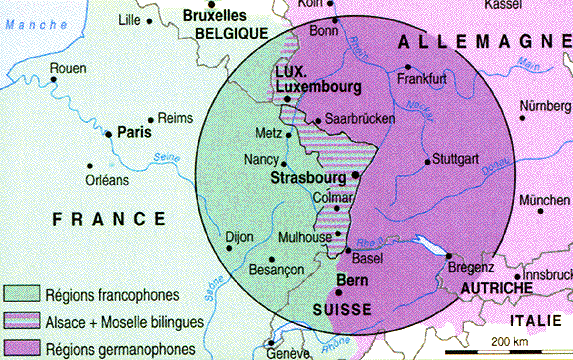
Within 250Km around Strasbourg live some 6 million French-speaking people and no less than 25 million German-speaking people. Those citizens from the heart of Europe spread over 6 countries : France, Switzerland, Germany, Luxemburg, Belgium and Austria. |

|
|
|
Alsace and the German-speaking Moselle are located along the border of the German/Roman languages which have hardly varied over the last millenium. What is today called the Alsatian and used to be called German once, and then German Alsatian, stems from Alemanisch and Fränkisch dialects which were enforced in our region ever since the " great migrations "( in the 4th and 5th centuries). This linguistic space goes beyond the present national borders, and thus the Alemanisch language is spoken as much in Alsace as in Baden-Wurttemberg, as in German-speaking Switzerland, in Liechtenstein and in Austria (Vorarlberg), according to local miscellaneousness specific to each dialect. Dialects are spoken but non- codified languages. The language which has been standardized, written and codified and corresponding to our dialects is Standard German. Let us specify that those dialects, despite their constant evolution are previous to Standard German which is a language of great communication (koinè) and started its developement in the 15th century. An Alsatian dialect speaking will learn Standard German more easily. ( Standard German results from both "Mitteldeutsch " and " "Oberdeutsch "dialectal spaces to which those speeches belong) according to a teaching method actually adapted to the region. Standard language and dialects have different functions. There is no hierarchy. A language is not only a mean of communication, it also has an expressive function. It is an identifier which belongs to the indigenous native speech. The fact that the Alsatian language belongs to the German linguistic area does not mean obviously that it has no peculiarities or any interferences with French in particular, but that affects neither its historical relationship, nor its structure. There are few dialect-speaking who only know one kind of language in Alsace. According to people in concern and the environment, either the dialect or French can be used ; with bilingual speaking, both can alternate (code switching), this can show a failure, but can also be a game. If the relationship between Alsatian and German is no longer apprehended in popular consciousness, this can be explained in particular by the rejection of German after 1945, following the trauma of the annexation and the National-Socialist terror. Whereas we must cautiously keep the past in mind, we must now have a more unbiased and serene look at things. From these remarks results the definition of the regional language in its double dimension: Dialectal German and Standard German. This definition was officially given by Chief Education Officer Pierre Deyon in 1985 : "There is indeed but one definition of the regional language in Alsace which is scientifically correct, that is the Alsatian dialects whose written language is German. " ("Il n'existe en effet qu'une seule définition, scientifiquement correcte de la langue régionale en Alsace, ce sont les dialectes alsaciens dont l'expression écrite est l'allemand.")
Adrien FINCK - Emeritus Professor of German and Alsatian Letters Frédérick HARTWEG - Professor of Strasbourg Universities Raymond MATZEN - Ex Director of Alsatian Dialectology Marthe PHILIPP -Honorary Professor of Linguistics and Dialectology Robert Schuman University Strasbourg |
 |
 |
|
|
|