|
|
 |
 |
 |
 |
|
|
|
|
|
|
|
|
|
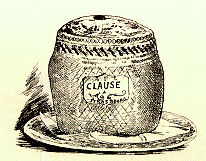
In 1762, Field-Marshal , Marquess of Contades was appointed Governor in Alsace in substitution for Marshal Coigny. At his arrival in Strasbourg he moved into the palace of the Military Government which stood then at the Nuée Bleue Street. Nowadays, the Central Police Station stands there instead. After the death in 1765, of the Countess of Lutzerbourg who was the owner of the « Château de l'Ile Jars » Field -Marshal of Contades lived there. At the end of that very same year, the governor of Alsace entertained Jean-Jacques Rousseau to dinner, according to one of his letters from those times. Rousseau stated thereby «he was honored with everyone's kindness and good-will from the Marshal himself to the common people.» In another letter Rousseau wrote he would have stayed much longer in Strasbourg with great pleasure if «the frequent dinners at Field-Marshal of Contades' hadn't tired him out.» In those days, the «Château de l'Ile Jars» was located in the middle of the forest so it makes it understandable that Fiel-Marshal of Contades had turned it his favorite residence. Besides, the distance which separated the «Château» from the military governement was easily covered. In fact it took him15 to 20 minutes to ride, by coach or on his horse. However he enjoyed himself so much in that lonely mansion that his friends were most welcome there. By the end of 1778, he had hired a young but remarkable cook named Jean-Pierre Clause. Clause was born in Dieuze (Moselle) on October 24th 1757. He was the son of Sébastien Clause (and not Close as it has been usually spelled) who was a cooper and of Françoise Tancier. After a start as a cook's boy in an inn at Évreux (that is why he was often granted a Norman extraction) he came to Paris along with his uncle Dumoulin. Then, he probably was sent for to Strasbourg by his elder brother who was a pastry-cook and who died on September 25th 1778. Clause who was then 21, entered the service of the Marshal of Contades where he would soon become the First Cook. Thus we can assert that his crust pie Foie Gras from Strasbourg was created between 1779 and 1783 instead of 1762 or 1776, as many historians have argued. So, once the field-marshal sent for Clause and told him : «I'm expecting some remarkable guests for tomorrow and I won't have rabbit with noodles on my table nor those everlasting Alsatian knefs, I want French cooking.» After a sleepless night it occurred to Clause that he would make a crust pie shaped as a round box which he would fill with full Foies Gras completed with veal force-meat and thinly minced back-fat. Then the whole thing would be covered up with a crust top and cooked in a slow oven. The back-fat had gently melted away while the livers kept cooking. At the first glance the work looked perfect. When the new dish appeared on the Marshal's table there was a general exclamation of surprise. Once the guests had tasted it they whispered, filled with a grateful wonder. Thus Brillat-Savarin expressed himself in his famous book «The physiology of taste» he wrote these words : «That Gibraltar of Foie Gras which kept everybody silent when it appeared on the table, fulfilling the hearts...so all the faces showed the heat of desire, the ecstasy of enjoyment and the full rest of bliss..» The marshal sent for Clause and highly congratulated him , in front of all his guests. On the next day, the marshal courteously dispatched to Versailles a gentleman from his suite and entrusted him with the offer of one of the delicious «pâtés» to the king of France. Louis XVI appreciated that marvel as he should and, according to the legend, he immediately answered back. The field-marshal was granted an estate in Picardy whereas Clause received a bonus of 20 Pistoles ! After his creation of the pâté so called «à la Contades» Clause did not stay long at the service of the marshal. As he married Marie-Anne Maring, the widow of the pastry-cook Jean-François Mathieu on February 10th 1784. The latter ran a shop at N°3 Marché aux Chevaux which later became N° 18 la Mésange Street (Nowadays it isHoll's Jewelry- and N° 15). As he had passed his mastership he had himself registered on February 28th 1784 at the «Tribu des Pâtissiers» (the pastry-cooks' tribe). So it was the very beginning of the Foie Gras trade which was the only privilege of Marshal of Contades who was a good-mannered Lord very fond of refined meat and an excellent host, until Clause's marriage. The most elaborate and delicate dishes were always included in the Marshal's menus, but when he treated noblemen from the provinces, he demanded that his Master-Cook should outdo. And Clause did outdo so much that he won his glory creating this wonder of his, the wonder of wonders which is the «pâté de foie gras» from Strasbourg. Hence it was from that house in the Mésange street that stemmed the fame of the Foie Gras from Strasbourg. It soon spread all over france, then Europe, up to the whole world. Clause died on November 21st 1827, at the age of 70 , in his home in Strasbourg. Field-Marshal of Contades had left Strasbourg for long as he had been discharged of his command in 1788. During 43 years Clause kept making his pâtés and increasing his production restlessly, so great was his fame . His successor was Fritsch who, in turn handed over the House to a nephew of Clause's, named Jehl, around 1846. The latter then, moved into N° 3 rue du Dôme. |
 |
 |
|
|
|