|
|
 |
 |
 |
|
|
|
|
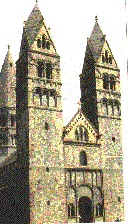
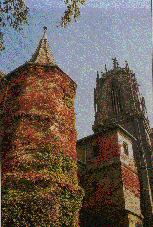
The town of Selestat (Schlestadt) was built on the site of Elsebus, which was destroyed by Attila. Then apparently, it stood as a residence for the Merovingian kings, then for the Carolingian kings. At of the end of the 11th century Selestat belonged to the family of Hohenstaufen. Friedrich II (Frederic) had the town surrounded with bulwarks. He also regulated the municipal administration. The art of varnishing pottery was created there in the 13th century. Under Rudolf (Rodolphe) of Hasburg, Selestat turned an imperial free town. It was part of the Décapole in 1354 and in 1473, of the "Basse Union" which was a league against the progression of the Burgundians on the Rhine. The city was the seat of the first humanistic school of South Germany, between 1441 and 1525.Vice-chancellor Dringenberg reorganized the Latin school. Such outstanding people as Jerome Guebwiller, Jacques Wimpheling, Martin Bucer did study or teach in Sélestat.The most famous of those school-members was Beatus Rhenanus. The city was struck by Protestantism but soon turned away , after the war of the Peasants or Bumpkins who had flared up against the lords and the monasteries in the 14th century,in Lower-Germany. During the Thirty Years War Selestat was besieged by Swedish troops and compelled to capitulate. The treaty of Westphalia yields the place to France. King Louis XIV had it fortified by Vauban. The Germans occupied it several times until it was definitively liberated in 1945.
|
|
|
|
http://www.semantic.fr/bibhum/ - (Friends of Selestat's Humanisitic Library) http://perso.wanadoo.fr/mediatheque.selestat/pageacc.htm - La Médiathèque de Sélestat |
 |
 |
|
|
|